The Hidden Liability Risk of Uncontrolled Workplace AI
Artificial Intelligence Is Already Inside Many Businesses
Artificial intelligence tools such as ChatGPT, Claude, and other generative AI platforms are rapidly becoming part of everyday work.
Employees are using AI to draft emails, analyze spreadsheets, summarize documents, write reports, and research complex topics. In many cases, this adoption is happening quietly and without formal approval.
For business owners, this creates a new form of shadow technology. Employees may use Shadow AI tools through personal accounts, free subscriptions, or applications the organization does not control.
While AI can dramatically improve productivity, unmanaged use introduces risks that many organizations have not yet considered.
Most discussions about AI focus on Cybersecurity or data privacy. Those risks are real. However, one of the most overlooked issues is the potential impact on business liability and professional responsibility.
The Real Problem: Uncontrolled AI Use
In many organizations today, employees have already started experimenting with AI tools for routine tasks.
Common uses include:
- Drafting client communications
- Analyzing financial or operational data
- Creating business reports
- Researching legal or regulatory information
- Preparing recommendations or proposals
The challenge is that these tools are often accessed through personal accounts or free versions that the company does not manage.
Business owners and IT teams frequently have no visibility into how these tools are being used or what data employees are entering into them.
This creates a situation where company information may be leaving the organization without anyone realizing it.
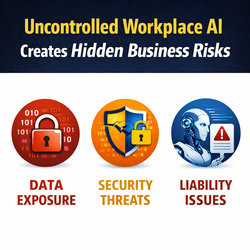
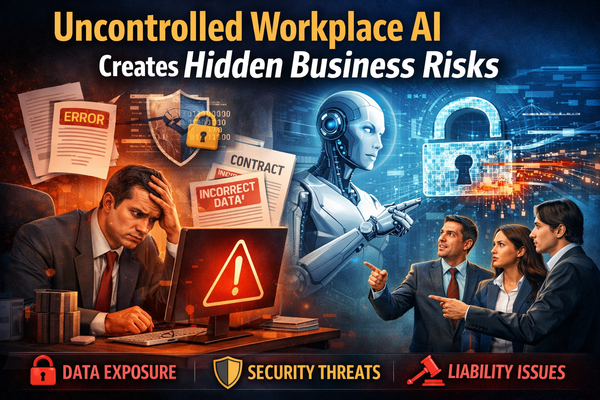
Data Exposure Is a Real Risk
When employees enter information into AI tools, that data may be processed by third-party systems outside the organization's control.
Depending on the platform and configuration, submitted information may be:
- Stored by the AI provider
- Retained for system monitoring
- Used to improve AI models
- Processed outside the organization’s security environment
This could expose sensitive business information such as:
- Client data
- Internal documents
- Financial information
- Proprietary intellectual property
Regulators are already taking data protection failures seriously. In 2024, New York regulators imposed penalties totaling more than $11 million against major insurers after cybersecurity weaknesses exposed the personal data of over 120,000 individuals.
While that case did not involve AI specifically, it demonstrates how organizations can face significant financial consequences when sensitive data is not properly protected.
AI Can Also Introduce New Cybersecurity Threats
AI platforms are creating new categories of cybersecurity risk that many organizations are not prepared for.
Examples include:
- Prompt injection attacks designed to manipulate AI systems
- AI-assisted Phishing campaigns that produce highly convincing messages
- Malicious prompts that attempt to extract sensitive data
These threats are evolving quickly, and many organizations have not yet implemented policies to manage them.
The Overlooked Risk: Business Liability
One of the most important risks asSOCiated with AI is professional liability.
Generative AI systems can produce incorrect, outdated, or misleading information while presenting it with high confidence. This phenomenon is often referred to as an AI hallucination.
If employees rely on AI-generated information to support decisions such as:
- financial analysis
- operational decisions
- client recommendations
- technical advice
- business strategy
If that information turns out to be incorrect, it could contribute to financial losses or disputes.
For organizations that provide professional services, this type of mistake could lead to claims for professional negligence or for inaccurate advice.
Automated Systems Are Already Creating Legal Disputes
Courts are beginning to see cases involving automated systems and AI-driven tools.
In one widely cited case, a tribunal ruled that Air Canada was responsible for incorrect information provided by its website chatbot. A customer relied on the chatbot’s instructions regarding a bereavement fare discount, and when the airline later refused the discount, the tribunal held the airline responsible for the chatbot’s statements.
The decision made it clear that automated systems are considered part of a company’s operations, and organizations remain responsible for the information they provide through those systems.
Regulators are also examining the impact of algorithmic decision-making in industries such as housing and real estate. In 2024, the U.S. Department of Justice filed an antitrust lawsuit involving algorithm-driven rental pricing systems used by property management companies.
Although the case involves pricing algorithms rather than generative AI, it highlights a key legal principle: companies remain accountable for decisions influenced by software or automated systems.
The Insurance Question Many Businesses Haven’t Asked
Another issue businesses rarely consider is how insurance policies respond to AI-related mistakes.
Many Errors & Omissions (E&O) and cyber liability policies were written before generative AI tools became widely used in business operations.
If a claim involves inaccurate AI-generated information, insurers may argue that the loss falls outside traditional policy definitions.
This could create coverage disputes between cyber liability policies, professional liability coverage, or other insurance protections.
As insurers evaluate the risks associated with AI, some are already exploring new policy exclusions or specialized coverage designed specifically for AI-related incidents.
The Problem With “Free AI” in Business
Many organizations unintentionally increase their risk exposure by allowing employees to use free AI tools or personal subscriptions.
From a business perspective, this creates several problems:
- The company does not own the AI account
- The company cannot control how data is handled
- The company cannot monitor or audit usage
- The organization cannot enforce security policies
Even paid AI subscriptions can introduce risk if they are owned by employees rather than the organization.
This means company data may be processed through tools that the business does not control.
A Better Approach: Controlled AI Adoption
Artificial intelligence should be implemented the same way organizations adopt any other business technology: with governance, oversight, and clear policies.
Businesses should focus on:
- Using company-managed AI platforms
- Establishing internal AI usage guidelines
- Restricting unauthorized AI tools
- Ensuring AI usage aligns with security and compliance policies
When implemented correctly, AI can significantly improve productivity while still protecting company data.
Managed AI Platforms Provide Greater Control
Many organizations are beginning to adopt AI platforms that integrate with existing systems and security controls.
For businesses already using Microsoft 365, tools such as Microsoft Copilot allow AI capabilities to be deployed within the existing environment while maintaining identity management, security controls, and compliance policies.
Other specialized AI platforms may still be appropriate for certain roles, but they should be approved and governed by the organization.
The Real Risk Is Not AI, but Uncontrolled AI Usage
Artificial intelligence is quickly becoming part of everyday business operations.
The real risk is not AI itself.
The real risk is uncontrolled use of AI tools with company data and business decisions.
Organizations that adopt AI with proper governance can benefit from increased productivity, better protection of sensitive information, reduced liability exposure, and compliance.
If your organization is evaluating AI adoption or is concerned about unmanaged AI use in the workplace, contact our team to discuss implementing AI securely within your business environment.
 Call Now!